

Comparing Five Dehumidification Methods To Reflect The Advantages Of Rotary Dehumidifiers
Leave a message
1. What is the cycle of the rotary dehumidifier?
The dehumidification work of the rotary dehumidifier can be said to be a cyclic process. Its specific text is as follows:
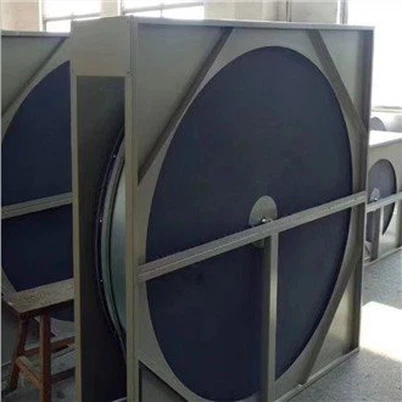
When the dehumidification work starts, the adsorption wheel is driven to rotate by the driving device until the adsorption wheel reaches a saturated state. At this time, the high-temperature air enters the regeneration zone, desorbs and regenerates, and reduces the humidity in the air, thereby achieving the purpose of dehumidification.
2. Description and comparison of several dehumidification methods
Cooling and dehumidification: The air temperature is first lowered to below the dew point, and then the condensed water is removed from the air. In this way, in standard dew point rotary dehumidifiers, it is more suitable.
Compression dehumidification: Compress, cool and separate air from water to achieve dehumidification effect. However, it should be noted that this method is not suitable for large processing volumes.
Solid adsorption dehumidification: The dew point can be reduced by adsorbing water on the solid hygroscopic agent through the capillary, but the side effect is that the adsorption area will be increased, thereby increasing the occupied area of the equipment.
Liquid absorption and dehumidification: The lithium chloride aqueous solution absorbs moisture, and its main disadvantage is that the absorption liquid needs to be replaced regularly.
Rotor adsorption dehumidification: dehumidification is carried out through the honeycomb rotor, and it also has a ventilation function.